Programming Encapsulation
- To program encapsulation, you should already have a solid understanding of what encapsulation in Object Oriented Programming (OOP) is.
How do you Define Encapsulation?
Get Methods
- The “get” method is a common naming convention for a type of method that is used to retrieve the value of an object’s private attributes (instance variables).
- These methods are also known as “getter” methods or “accessor” methods.
- The main purpose of a get method is to provide controlled access to the internal state (data) of an object without allowing direct modification.
- Attributes are often declared as private to achieve encapsulation, so cannot be accessed directly from outside the class.
- External code can use the public get methods to read the values of these private attributes (also known as instance variables).
Pseudocode
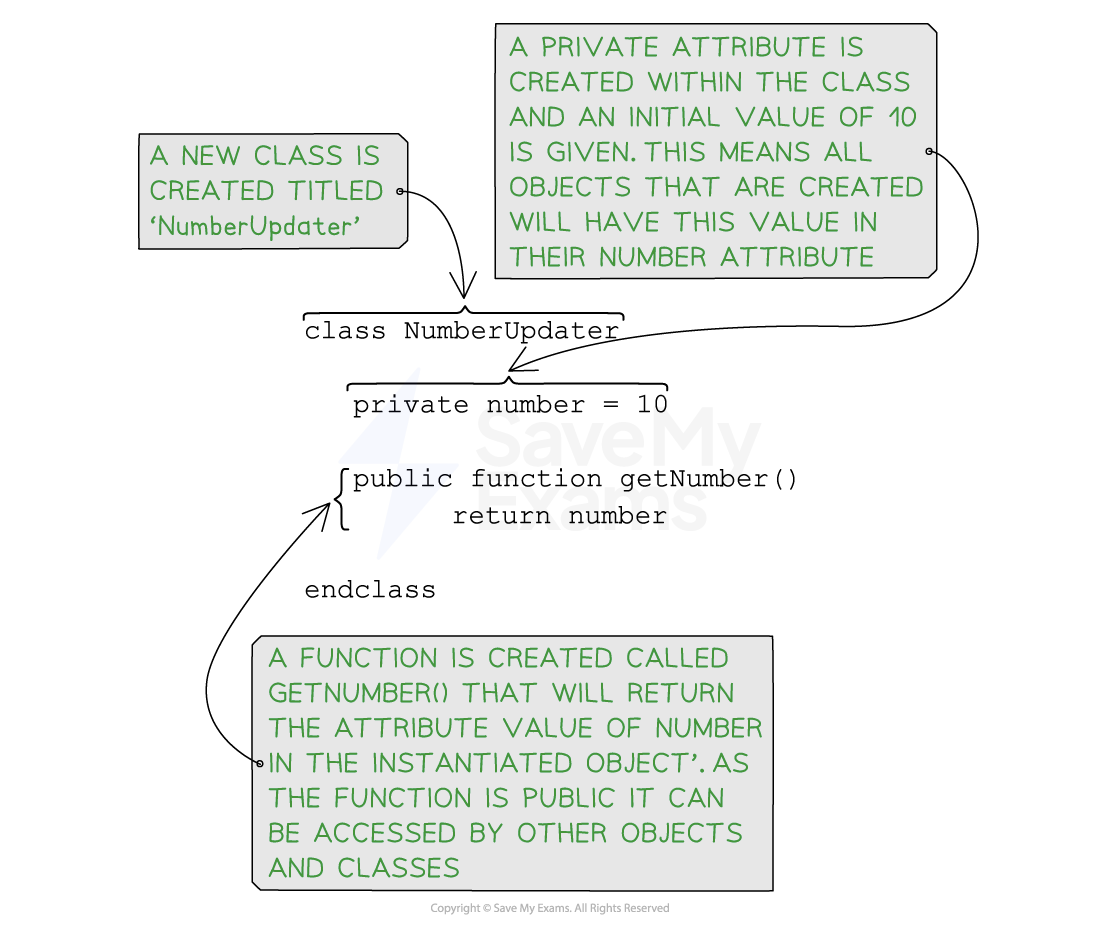 Pseudocode for a get method
Java
//creating a class called NumberUpdater
public class NumberUpdater {
     //setting the private attribute to the value of 10
    private int number = 10;
      //creating a get method that will return the value store in the number attribute
    public int getNumber() {
        return number;
    }
}
Python
#creating a class called NumberUpdater
class NumberUpdater:
     #setting the private attribute to the value of 10
    def __init__(self):
        self.__number = 10
      #creating a get method that will return the value stored in the number attribute
    @property
    def number(self):
        return self.__number
Set Methods
- The “set” method is a common naming convention for a type of method that is used to set the value of object’s private instance variables.
- Setter methods, also known as “setter” methods or “mutator” methods
- Generally additional code is written within the method to allow controlled access by enforcing certain conditions or validations before updating the attribute
Pseudocode
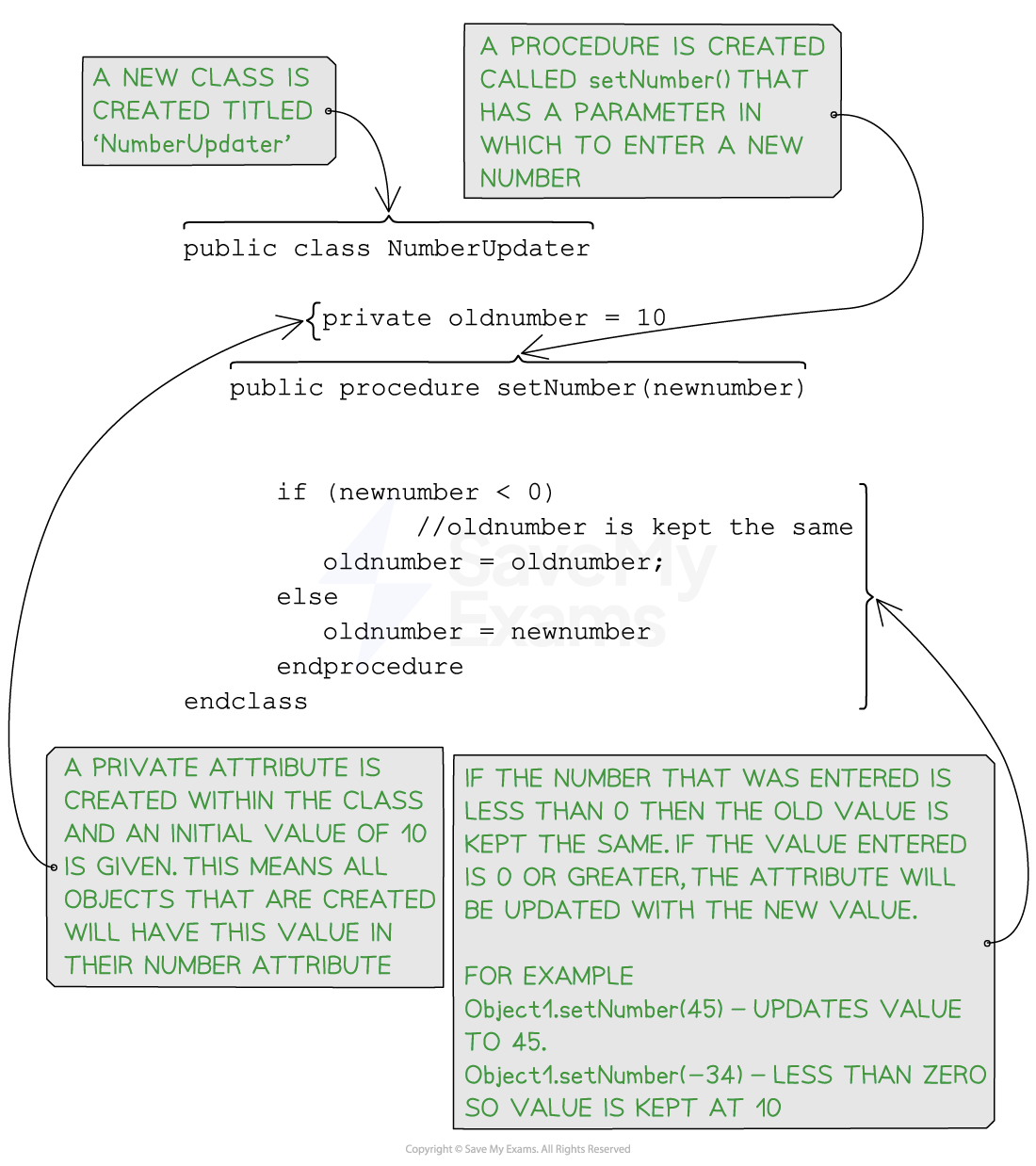 Pseudocode for a “setter” method
Java
//creating a class called NumberUpdater
public class NumberUpdater
     //setting attribute value to 10
    private int oldnumber = 10;
      //creating a set method
    public void setNumber(int newnumber) {
       //if the new number is less than zero
        if (newnumber < 0) {
           //oldnumber is kept the same
            oldnumber = oldnumber;
        } else {
           //oldnumber is updated with the new number value
             oldnumber = newnumber;
        }
    }
}
Python
//creating a class called NumberUpdater
class NumberUpdater:
     //setting attribute value to 10
    def __init__(self):
        self.__oldnumber = 10

      //creating a set method
    def setNumber(self, newnumber):
       //if the new number is less than zero
        if newnumber < 0:
             //oldnumber is kept the same
            self.__oldnumber = self.__oldnumber
         else:
            //oldnumber is updated with the new number value
            self.__oldnumber = newnumber