Karnaugh Maps
What is a Karnaugh map?
- In A Level Computer Science, a Karnaugh map is a tool that is used for simplifying Boolean algebra expressions
- It offers a visual method of grouping together expressions with common factors
- The format of the map makes it easy to identify and eliminate redundant terms
- They are used in digital logic design, such as simplifying the logic of digital circuits
Steps
- Create the Map: Each cell in the grid corresponds to a term in the Boolean expression. Fill cells with 1s and 0s corresponding to the output of that term
- Grouping: Group the 1s in the grid. Each group must be a rectangle and the size of the group must be a power of 2. A cell can be part of multiple groups
- Simplifying: Write down a simplified Boolean expression for each group. The simplified expression for a group consists of the variables that remain constant in all terms in the group
- Final Expression: Combine the simplified expressions from each group using OR operations to get the final simplified Boolean expression
Creating Karnaugh Maps
- A Karnaugh Map (KMap) can be used to simplify a Boolean expression with 2 inputs
- Here is an example for the expression A V B (A OR B)
Step 1
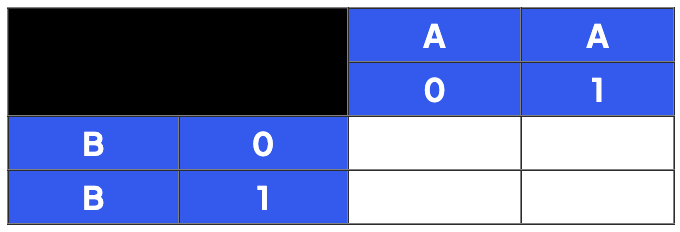
- Add each variable starting with A at the top and B down the side
- Add each possible state for A and B
 step 1
Step 2
- Take each expression in turn separated by the V (OR)
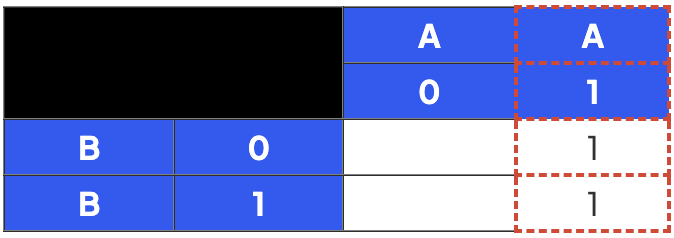
- First look at A on it’s own
- Find all cells where A is 1
- Add 1 to the cell
 step 2
Step 3
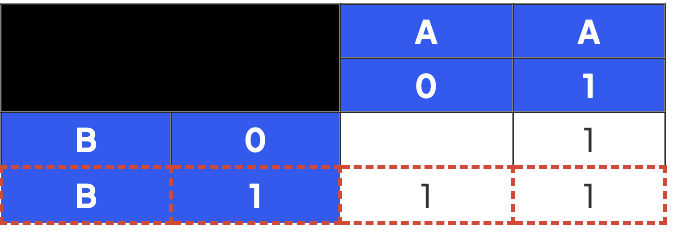
- Repeat for B
 step 3
Step 4
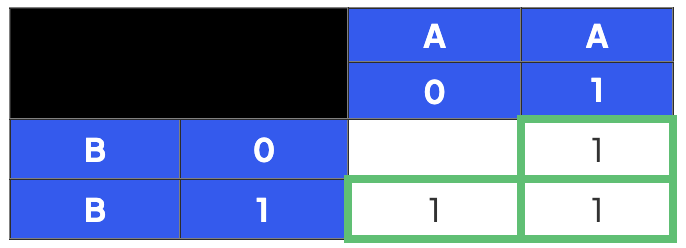
- This is now a completed KMap for the expression A V B (A OR B)
 step
step
Simplifying Expressions Using Karnaugh Maps
Simplify using a KMap.
In this example there will be 3 variables A,B and C so the empty KMap will look like this:
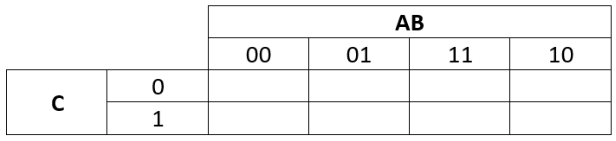 empty-k-map
Step 1
Split this long term at each OR giving 4 smaller expressions (subterms) to add to the table:
Step 2
- Take the first subterm
- Put a 1 in the map for every cell where this term would be TRUE (1)
- So if A and B were 0 and C was 1 this subterm would be 1
- So put a 1 in every cell in the KMap where A is 0, B is 0 and C is 1
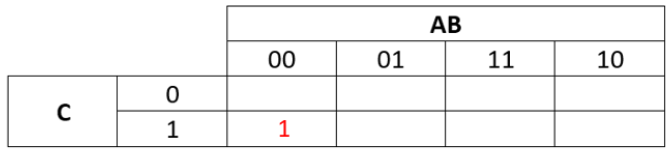 k-map-2
Step 3:
- The next subterm is
- Put a 1 in the KMap where A is 0, B is 1 and C is 0
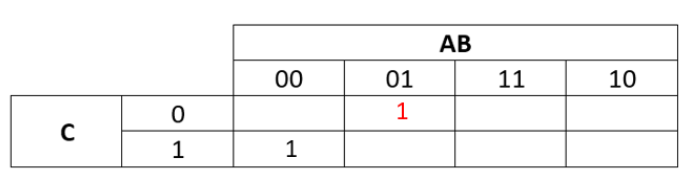 k-map-3
Step 4:
- The next subterm is
- Put a 1 in the KMap where A is 1, B is 0 and C is 1
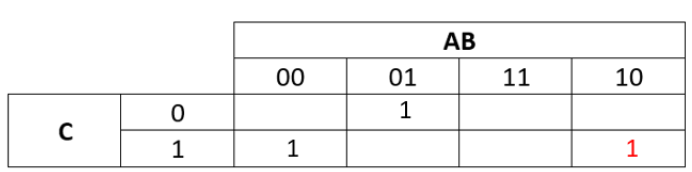 k-map-4
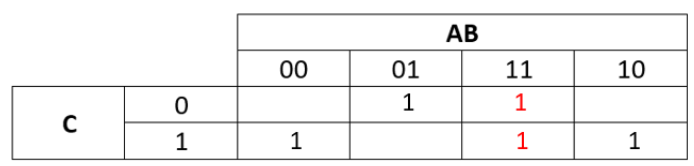
Step 5:
- The final subterm is
- Put a 1 in the KMap where A is 1 and B is 1 (2 cells this time)
 k-map-5
Making the groups
- Once you have written the 1s and 0s into your KMap, you can then use this to simply the expression
- In order to do this, you need to identify the groups
- This is the key to using the Karnaugh map to derive the simplified expression
- The aim of making the groups is to
- Make rectangular groups
- Make groups that are as large as possible
- Make groups that contain either 8,4,2 or 1 ones
- Groups can overlap (i.e. some ones can be in multiple groups)
- The Karnaugh map ‘grid’ wraps round in all directions so the groups can wrap round
Example grouping
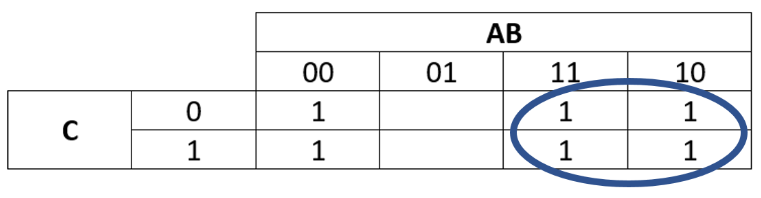
Group 1:
So this would be one group.
 k-map-6
This group would represent since within this group both and change (have zeros and ones) whereas for all the cells are one.
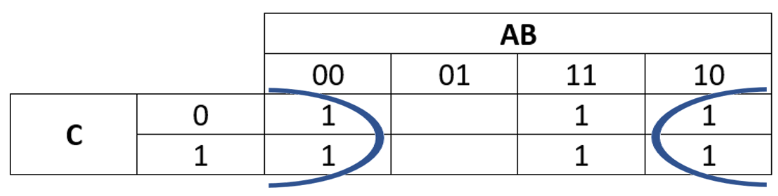
Group 2:
This would be another group (note the wrapping around).
 k-map-7
This group would represent since within this group both and change (have zeros and ones) whereas for all the cells are zero
Final simplified expression
- To get the final simplified expression we OR the terms representing the two groups together.
- So the simplified expression is
Examiner Tips and Tricks
In questions where you have to use a Karnaugh Map always show the groups by drawing a box/circle round them.
Worked Example
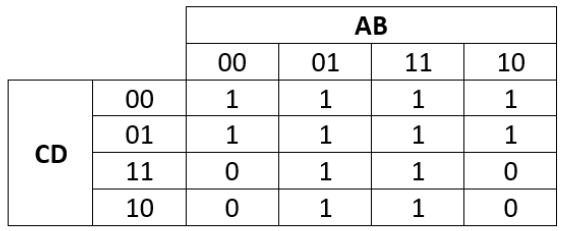
A Boolean expression is entered into a Karnaugh map.
 k-map-8
Give a simplified version of the expression using the Karnaugh map.
You must show your working
[3 marks]
How to answer this question:
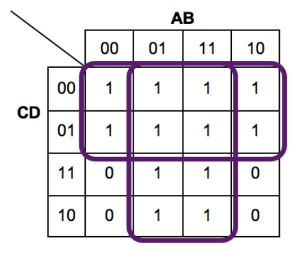 k-map-9
- Looking at the group of 8 in the middle of the map, for all the cells in the group the variable is always a 1
- The 3 other variables change across the group (i.e. for some cells they are 0 and for others they are 1
- So this group is
- Looking at the other group of 8, for all the cells in this group, is always 0 but the other 3 variables can be 1 or 0 in this group So this group simplifies to
Answer that gets full marks: