What is a Half Adder Circuit?
- A basic digital circuit used in computation to perform the addition of two single-bit numbers
- It has two inputs, usually labelled as A and B
- It produces two outputs: Sum () and Carry out ()
Half Adder Logic
The logic can be expressed using Boolean algebra:
- Sum (): (A XOR B)
- Carry (): (A AND B)
Truth Table
| A | B | Carry () | Sum () |
|---|---|---|---|
| 0 | 0 | 0 | 0 |
| 0 | 1 | 0 | 1 |
| 1 | 0 | 0 | 1 |
| 1 | 1 | 1 | 0 |
Calculation Tip:
- Remember that you are simply adding the binary numbers represented by A and B
- (Sum 0, Carry 0)
- (Sum 1, Carry 0)
- (which is , so Sum 0, Carry 1)
Circuit Diagram
A half adder consists of one XOR gate (to calculate the Sum) and one AND gate (to calculate the Carry).
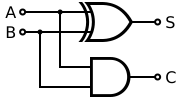 *Half Adder Logic Gates*
Full Adders
What is a Full Adder Circuit?
- Extends the capabilities of the half adder to handle the addition of three bits
- This allows for the inclusion of a carry bit from a previous addition operation
- It has three inputs: A, B, and an input carry ()
- It produces two outputs: Sum () and Carry out ()
Truth Table
| A | B | Carry () | Sum () | Value () | |
|---|---|---|---|---|---|
| 0 | 0 | 0 | 0 | 0 | 0 |
| 0 | 0 | 1 | 0 | 1 | 1 |
| 0 | 1 | 0 | 0 | 1 | 1 |
| 0 | 1 | 1 | 1 | 0 | 2 () |
| 1 | 0 | 0 | 0 | 1 | 1 |
| 1 | 0 | 1 | 1 | 0 | 2 () |
| 1 | 1 | 0 | 1 | 0 | 2 () |
| 1 | 1 | 1 | 1 | 1 | 3 () |
Calculation Tip:
- The full adder adds three inputs: A, B and
- The total sum can be 0, 1, 2 or 3
- Write the result as a 2-bit binary number in the output columns
- Example: If A=1, B=1, =1, the total is 3. In binary, 3 is , so is 1 and is 1
Circuit Diagram
A full adder is constructed by combining two half adders and an OR gate.
- First Half Adder: Adds A and B to produce a partial sum and partial carry
- Second Half Adder: Adds the partial sum to
- OR Gate: Checks if either half adder generated a carry bit to produce the final
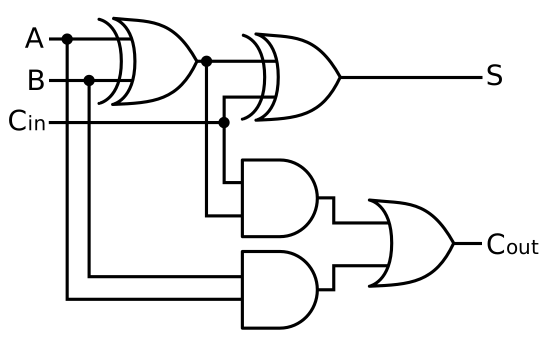 *Full Adder Logic Gates*
Ripple Carry Adders
A single full adder can only add single binary digits. To add larger binary numbers (e.g. 4-bit or 8-bit numbers), we must connect multiple full adders together.
- This configuration is known as a Ripple Carry Adder
- To add two -bit numbers, you need full adders
- The from one adder is connected directly to the of the subsequent adder
- This represents the fundamental arithmetic process inside a CPU’s Arithmetic Logic Unit (ALU)
<img src=“https://upload.wikimedia.org/wikipedia/commons/5/5d/4-bit_ripple_carry_adder.svg” alt=“Ripple Carry Adder” width:“500” /> Ripple Carry Logic

Worked Example
Question: A half-adder circuit is shown in the diagram below.
Describe how this logic circuit can be adapted to add together two 4-bit binary numbers. [4 marks]
Answer:
- Step 1: The current circuit is a half adder, which only adds two bits. To add larger numbers, we first need to create a Full Adder
- Step 2: This is done by joining two half adders together with an OR gate
- Step 3: To add two 4-bit numbers, we need to connect 4 Full Adders together in a chain
- Step 4: This is achieved by taking the Carry Out () from the first adder and connecting it to the Carry In () of the next adder in the sequence (a Ripple Carry Adder)